Diagnosed with a rare, genetic disorder
Evie is an energetic five year old who dances, trampolines and races about on her scooter. Evie loves nothing more than going to the park with her younger brothers Wilf and Albie. At just five years old Evie was diagnosed with A-T a rare, life-limiting condition which currently affects 150 people in the UK.
Evie sometimes gets ‘wobbly legs’ and finds it hard to get down stairs. Her wobbly legs are the start of a deterioration which will eventually take away her ability to walk, feed herself and write.

Just before her fifth birthday, Evie was diagnosed with ataxia-telangiectasia (A-T). A-T is a genetic, neuro-degenerative disorder whereby a mutation occurs on a particular gene, known as the ATM gene, meaning it cannot carry out its function properly. Children with A-T appear healthy until school age when they will show signs of decreased muscle control. Gradually all physical functions shut down and they will need to be in a wheelchair by the age of 10. Children with A-T are more susceptible to certain cancers than the general population and many will have very weak immune systems.
When Evie was three, her parents Toby and Emily Read were told by Evie’s nursery that Evie wasn’t walking as she should be. A physiotherapist diagnosed Evie with hypermobility, but the wobbly legs continued and two years later Evie’s school teacher said she was concerned that Evie’s fine motor skills weren’t as developed as those of her classmates.
Getting a diagnosis for Evie
Toby and Emily took Evie back to the physiotherapist and as Emily explains,“Because I had experienced a difficult pregnancy and Evie had been born with the help of forceps, Evie was initially diagnosed with cerebellar ataxia, a condition that affects balance and co-ordination but isn’t progressive.”
Toby and Emily hadn’t yet seen a paediatrician and had a wait of two weeks before their first appointment. In this time Emily began to research Evie’s symptoms in more depth.
“I’d noticed that Evie had small red spider veins in her eyes,” says Emily. “It wasn’t something that the doctors or Toby has picked up on and I’d just put it down to tiredness. However, when I typed ataxia (difficulty in controlling and co-ordinating movements) and spider veins into Google, I came across A-T. When I started to research it more, I just knew it was what Evie had.
When Toby returned home that evening, I told him to read the information I had found. I heard him cry out when he recognised the symptoms that Evie had.
When we went to see the paediatrician I immediately handed her a piece of paper with ataxia-telangiectasia written on it. I hadn’t yet got used to these new words and at this point struggled to say them out loud. The paediatrician took it and told me that Evie wouldn’t have A-T because it is so rare and only very infrequently in her career had she seen any children with the condition.
Evie was referred for an MRI, ECG, blood and urine test. The paediatrician explained to us that if Evie’s urine test came back with a high level of alpha fetal proteins (a protein that is high in children with A-T because of their lack of ATM protein) then there would be a high possibility of Evie having A-T.
When the paediatrician’s secretary called us the next morning she asked us to come to the hospital, without Evie. When we arrived there were no other children or parents around and it was clear that the doctors and nurses were avoiding eye contact with us.
We were told that it was a near certainty that Evie had A-T. The further tests that Evie had undergone, confirmed this diagnosis six weeks later.
In this time, Wilf, 3, and Albie, 1, were tested for A-T. As Toby and I are both carriers of the A-T gene, Wilf and Albie each had a 1 in 4 chance of also having A-T. Both tests were clear.”
Living with A-T
“Evie is now approaching her sixth birthday, a year since her diagnosis. Evie knows that she gets tired and sometimes needs to go in the buggy and we have told her that one day she will need a wheelchair. Wilf also knows that Evie isn’t as strong as he is and will help her when she gets tired.
Since her diagnosis, Evie continues to be an avid dancer and trampolinist. If you saw Evie in the supermarket you might think she looks a little tired but you wouldn’t notice anything other than that. For us, we can see that while Evie has grown taller over the past year she is thinner and looks quite frail.
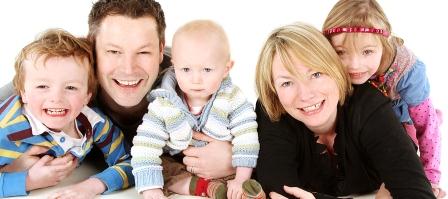 At home Evie will slide down the stairs on her bottom but at school she wants to be just like any of the other children so will walk down the stairs, either holding someone’s hand or going down side ways.
Toby and I set up our own charity, Action for A-T, pretty quickly after Evie was diagnosed. We wanted to change the future for A-T and we really believe the only way to do that is to fund more medical research.”
Action for A-T , along with the A-T Society have now partnered with Sparks on a new research grant round specifically for A-T.
“The research grant round for us is absolutely fantastic,” Emily says, “There has never been a dedicated research fund in the UK specifically for A-T so for this to happen now is an incredible achievement. We see medical research as the only way to change the future of A-T .”
For now Evie will continue to have annual checks at Great Ormond Street hospital and care will start when she needs it.